
The key to growth is knowing where and how a business derives value
In a recent article I posted here titled “Product Operating Model: What It Looks Like”, I discussed one of the core tenets of successful products. The core tenet for any product or service is to identify and understand where value is derived, called value streams.
This is more than just knowing what business or industry the business operates in. It is about understanding the business at a deep level, from how the organization derives value to digging deeper into its operational workflows.
To solve any problem, you must first understand it. You don’t have to be the expert – unless you are the founder and we are talking about your own business. Otherwise, you do need to know who the experts are and what questions to ask.
Whether you are reading this article looking for ways to improve your business, or whether you are reading it to uncover ways to help your customer, you can use the information below to help you.
Your first source of the experts is your customer.
Determine how your customer derives value
Regardless of whether your customer is new to you or the customer has been with you since you founded your company, it is critical to always keep in touch with how they are deriving value. What’s working for them? What’s not working quite so good anymore? Remember that strategies change, revenue sources dry up, and life happens. Your customer’s business will change to adapt to that.
The first expert you need to work with is the customer representative, preferable a manager or higher who has a stake in developing vision and strategy for the company.
The information that you gather from your conversation(s) can be captured and maintained in any customer relationship management (CRM) application. As a central source of information about your customer, it is always accessible by anyone who needs to determine how to improve the customer’s experience.
The key components of the values that drive your customer’s business include:
- Key partnerships
- Key activities
- Key resources
- Customer relationships
- Cost structures
- Revenue streams
As you talk with your customer representative, either in one session or over a series of sessions, structure your questions around these key components, capturing what is said. Make a process of updating the information regularly, which will not only improve your understanding of your customer but serve to deepen the relationship.
Create a Business Model Canvas to illustrate the information about your customer. A Business Model Canvas pulls all of the key components for a business into an easy and comprehensive visual aid. Here is an example created for Planet Fitness.

By keeping tabs on the organizational components of how your customer derives value, you will improve your capability to offer them winning solutions to their problems.
If you would like to find out how this applies to your business or how to get started building a Business Model Canvas, contact us!
Learn your customer’s current processes and workflows
In addition to analyzing your customer’s key components, it is critical to get a full understanding of their current processes and operational workflows. It can come from the customer representative, if that representative is close enough to the operations. However, the experts for this could be the end users of the process or those who represent the end user.
It can take several sessions to gather the information, depending on the problem. Your goal is to capture processes that are directly related to the company’s value streams and to uncover gaps and inefficiencies. Again, your focus will depend on the customer’s problem.
There are several ways to represent these data elements. Which method you choose depends on:
- whether you are focused on one process or many processes
- whether or not the processes are interrelated
- whether or not you want a high-level view
In their article titled “What Value Stream Mapping Is – and What It Is Not”, LeanSixSigma.com lists four methods of value stream mapping.
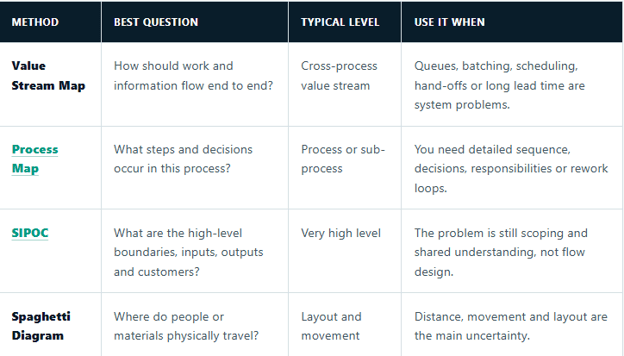
Here is an example of a value stream map.

As you might have noticed, you are capturing the current processes here, not the future and not the solution. You cannot provide a solution or recommend improvements until you know the details about the problem.
Value stream mapping is a critical process in gaining deep understanding of your customer and their business operations. With that understanding, you can provide better solutions that will actually result in delivering more value and better outcomes and not just another feature or process.
A final thought: value assessments can change over time. So you should expect to repeat this process, either in part or in whole, over time. The focus is to continue to build the customer relationship as well as provide better outcomes.
Early in my career, during a contentious meeting about delivering a feature that a customer had asked for, one of the founders said “The customer is always right.” In this case, the customer wasn’t going to have to pay for the enhancement, it didn’t fit into the current strategy, and the value that would be delivered in the end after heavy effort was questionable at best.
That has always stuck with me and today I looked up the quote. It was a slogan popularized by successful retailers beginning around 1908 and originated from a statement that Marshall Field. The original intent, according to Wikipedia, “advocated that customer complaints should be treated seriously so that customers do not feel cheated or deceived.”
It’s not that we should never say no to our customers, but that we should do our due diligence so that we can present them with a better outcome.
If you are interested to find out how you can apply these ideas to your business, contact us. Definitely keep coming back here!


Writing has become somewhat of a passion for me over the years. Whether I am writing in my journal, writing technical documents for my job, or creating a piece of inspiration that began as catharsis and results in a shared perspective, I love to write. Most times, I flourish in writing where I fumble in spoken words.
Thanks for visiting my blog.
Hope to hear from you at some point!
